🔱🕳️ Achaleśwar Mahādeva — The Shrine of the Unseen Depth (Dholpur Ravines, Rajasthan)
🌑🌬️🕯️
In the rugged ravines of Dholpur, where the earth breaks into deep cuts and the wind moves through silent gullies, there is a place where Śiva is not seen — only sensed. No liṅga rises from a pedestal. No stone form meets the eye. Instead, there is a dark opening in the ground, a vertical depth that disappears into shadow.
This is Achaleśwar Mahādeva.
A shrine where the devotee does not look at Śiva, but into Him.
The land here is harsh and ancient. Ravines curve like dried rivers turned to stone. Paths descend and rise without pattern. Reaching the shrine itself feels like entering a geography shaped by time and austerity. Few travelers come here, not because it is unknown, but because it demands intention to arrive.
🕳️🌌
At the center of a small stone platform lies the pit — circular, quiet, and impossibly dark. One leans slightly to peer inside, but the eye meets nothing. The darkness is complete, absorbing light without return. Villagers say that if a stone or offering is dropped, no sound of it striking bottom is ever heard.
Whether depth or echo plays this mystery, the experience remains the same.
You are standing before Śiva as void.
🌑🕉️
In Vedic thought, Śiva is not merely form. He is śūnya and ananta — emptiness and infinity together. The liṅga itself is a symbol pointing beyond shape. At Achaleśwar, even that symbol dissolves. Only depth remains.
The Purāṇas speak of Śiva as the endless pillar of light seen by Brahmā and Viṣṇu, whose beginning and end could not be found. Here, that teaching is lived through earth instead of flame. The pit becomes the reminder that the Divine cannot be grasped by sight or measure.
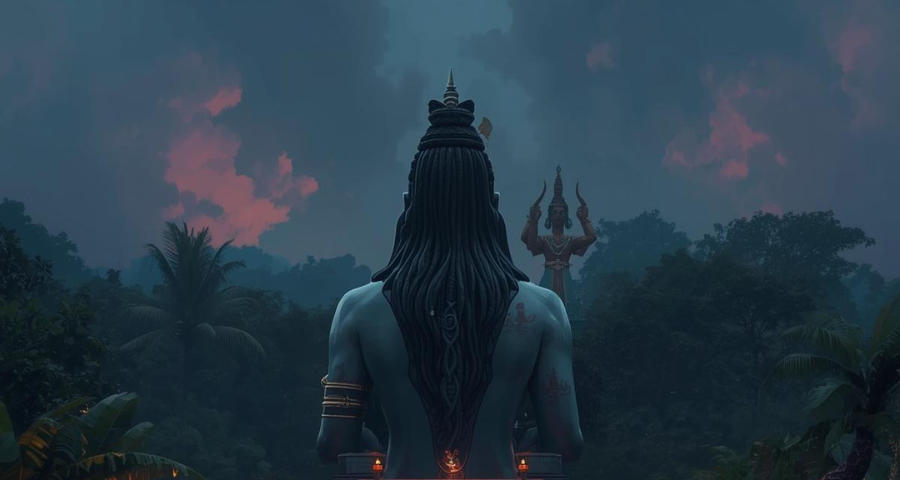
One does not decorate this shrine. One does not circle it in elaborate ritual. One stands, offers water or a leaf into the darkness, and feels the mind fall inward with it.
🌬️🪨
Wind moves freely across the ravines, carrying a low, hollow sound that feels like a distant chant. The surroundings are bare, with sparse vegetation clinging to soil carved by ages. This landscape itself mirrors the austerity of the shrine — stripped of excess, reduced to essentials.
Local tradition holds that ascetics once chose this place precisely because nothing here distracted the mind. With no image to gaze upon, attention turns inward. With no structure to admire, awareness settles into depth.
🕯️🌿
Villagers approach quietly, bowing before the opening in the earth. Some light a small lamp at its edge. Some drop flowers or bilva leaves into the unseen. The act is simple, almost stark. Yet it carries a profound symbolism — surrendering offerings into that which cannot be perceived.
Here, Śiva is worshipped not as presence before you, but as the abyss within you.
🌌🧘
Standing at Achaleśwar for even a few minutes creates an unusual experience. The eyes search for form and find none. The mind, deprived of object, begins to settle. Thoughts feel like they too are falling into the depth, disappearing without sound.
This is meditation without instruction.
The pit becomes a mirror of inner consciousness — unfathomable, silent, without boundary.
🕉️ Vedic Meaning of Achaleśwar
🕳️ The pit represents śūnya — the void beyond form.
🌌 Symbol of the infinite depth of Brahman.
🕯️ Worship without image aligns with nirguṇa contemplation.
🌿 Tapobhūmi suited for ascetics and inward practice.
🧘 A place where attention naturally turns within.
🙏 How to Pray Here
💧 Offer a little water into the pit.
🍃 Drop bilva leaves or flowers gently.
🕉️ Chant softly or remain in silence.
🧘 Stand or sit quietly for a few minutes, gazing into the depth.
🤫 Avoid noise; let the place speak through stillness.
📍 How to Reach
- Location: Dholpur district, Rajasthan (ravine region)
- Reachable via local village roads and footpaths into ravines
- Final approach requires careful walking on uneven terrain
Best visited during daylight hours.
⚖️ Pilgrim Conduct
- Be cautious near the edge of the pit
- No littering or disturbance
- Maintain silence
- Respect the stark simplicity of the shrine
- Visit with awareness, not curiosity alone
🏛️ Who Built This?
No formal builder is known. The platform around the pit was later arranged for safety, but the sacred focus — the depth in earth — is entirely natural.
🧭 10 Things Every Bhāratiya Should Know
- No visible liṅga — worship of Śiva as void
- Natural deep pit as sacred focus
- Rare example of nirguṇa style worship
- Located in ancient Dholpur ravines
- Ideal for silent contemplation
- Reflects Purāṇic idea of infinite Śiva
- Minimal ritual, maximum inwardness
- Little known and rarely visited
- Landscape itself reflects austerity
- One leaves with a sense of inner depth
At Achaleśwar, you do not see Śiva.
You experience the vastness where seeing ends.
Har Har Mahādev 🔱
https://www.instagram.com/sanathanayatra/
https://www.facebook.com/profile.php?id=61583124183564
https://www.linkedin.com/company/sanathana-yatra/
https://x.com/SanathanaY