
🕉️ Kailasa Temple — The Mountain Carved from a Single Stone
Where devotion defied gravity, and an entire temple emerged from living rock ⛰️🪔An Invocation — When Stone Becomes Vision
There are temples built stone by stone.
There are temples assembled over generations.
And then — there is Kailasa.
A temple not constructed upward,
but revealed downward.
A monument so extraordinary that it appears less like architecture and more like a mountain transformed by devotion.
Sacred Inspiration — Bringing Kailāsa to Earth
The temple is dedicated to Shiva.
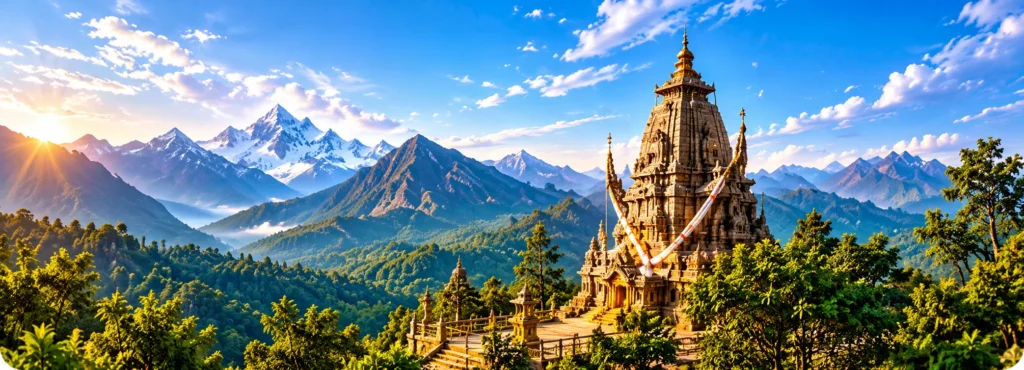
Its very name invokes Mount Kailāsa, the sacred abode of Shiva.
Yet the builders did not merely imitate a mountain.
They sought to manifest its spiritual essence.
A place where earth and heaven seem to meet.
The Impossible Idea
Most temples begin with foundations.
Kailasa began with a cliff.
Instead of carrying stones to a construction site, ancient artisans removed stone from an entire hillside.
What remained became the temple.
The question was not:
“What shall we build?”
But:
“What can we reveal that is already hidden within the rock?”
Monolithic Architecture — One Living Stone
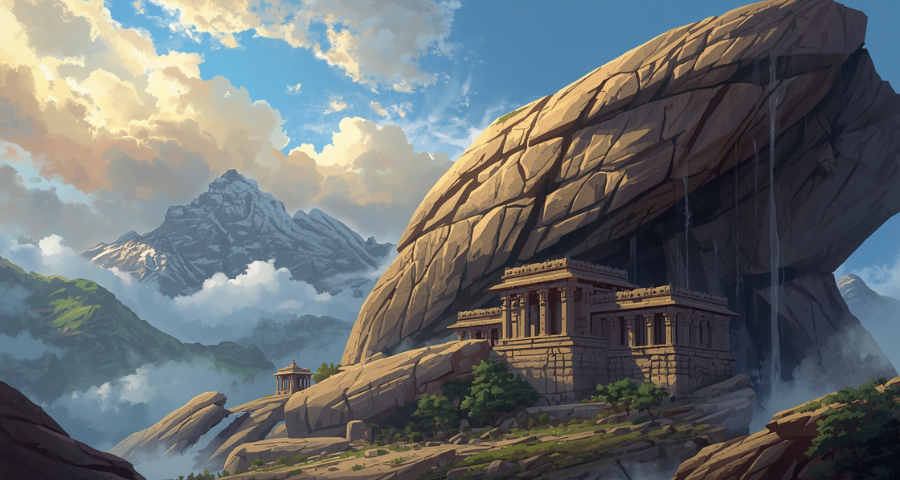
Kailasa is among the world’s greatest examples of monolithic architecture.
It was carved from a single massive rock formation.
No separate blocks.
No assembled pieces.
The pillars, halls, shrines, stairways, sculptures, and towers all emerge from one continuous mass of stone.
The temple is not placed upon the earth.
It remains part of it.
Excavating from the Top Down
Perhaps the most astonishing aspect of Kailasa is its method of creation.
The artisans carved from the top downward.
They first defined the highest portions of the structure.
Only then did they work toward the lower levels.
One mistake could have ruined the entire project.
There was no easy correction.
Every cut demanded precision.
Every strike required vision.
Vertical Temple Engineering
Kailasa is a masterpiece of vertical engineering.
The builders imagined the entire structure in three dimensions before removing vast quantities of stone.
They had to visualize:
- Towers before foundations were exposed
- Courtyards before open space existed
- Sculptures before surfaces appeared
This required extraordinary planning.
The temple existed in the minds of its creators long before it appeared in stone.
A Mountain Hollowed into Sacred Space
Walking through Kailasa feels unlike entering a conventional temple.
The temple seems to have emerged naturally from the earth itself.
Courtyards open unexpectedly.
Passageways reveal hidden shrines.
Massive walls rise from the living rock.
The mountain is not the backdrop.
It is the temple.
Sculptures That Breathe with Movement
Every surface carries remarkable carvings.
Scenes from sacred narratives unfold in stone.
Gods, sages, celestial beings, and guardians appear with extraordinary vitality.
Among the most celebrated panels are depictions of Shiva in dynamic forms.
The rock appears motionless.
Yet the sculptures seem alive.
The Scale of Devotion
Kailasa is not impressive merely because it is large.
It is impressive because of the vision behind it.
Thousands of tons of stone were removed.
Years of labor were invested.
Generations may have participated.
This was not construction for prestige alone.
It was devotion expressed through unimaginable commitment.
Symbolism of the Vertical Journey
The temple’s upward-reaching forms symbolize ascent.
From earth toward heaven.
From ignorance toward understanding.
From limitation toward liberation.
Its verticality is more than architectural.
It is spiritual.
Every level suggests a movement toward higher awareness.
The Union of Art, Engineering, and Faith
Kailasa demonstrates something remarkable about ancient Indian civilization:
Art was not separate from spirituality.
Engineering was not separate from devotion.
Knowledge and faith worked together.
The temple is simultaneously:
- A sacred sanctuary
- An engineering marvel
- A sculptural masterpiece
All united within a single vision.
Time, Endurance, and Wonder
Centuries have passed.
Empires have risen and fallen.
Yet Kailasa continues to inspire awe.
Its endurance reflects more than the strength of stone.
It reflects the strength of human imagination guided by purpose.
The temple remains a reminder of what becomes possible when skill serves something greater than itself.
The Teaching — Carving Away the Unnecessary
Kailasa offers a subtle lesson.
The builders did not create the temple by adding.
They revealed it by removing.
Spiritual growth follows a similar principle.
We do not become complete by accumulating endlessly.
We become clear by letting go:
- Of ignorance
- Of fear
- Of false identity
What remains is our deeper nature.
🕉️ Closing Reflection — The Temple Hidden Within
Kailasa Temple leaves us with a profound question:
What if your highest self is already present?
What if it does not need to be built?
What if it simply needs to be uncovered?
Like the artisans who revealed a temple from a mountain,
life invites us to carve away what obscures truth.
And when the unnecessary falls away,
the sacred that was always there
stands revealed in its full majesty ⛰️✨🪔