
🕉️ Tulsidas — The Saint Who Turned Devotion into Living Poetry
Where the Name of Rāma became breath, and love became liberation 🌺
An Invocation — When Words Become Worship
There are poets who write to be remembered.
There are poets who write to be admired.
And then there are those whose words become pathways.
Tulsidas did not compose to create literature.
He composed to create connection.
In his verses, language dissolves into devotion.
Meaning melts into feeling.
Reading him is not an intellectual act —
it is an inward movement.
As if each word gently asks:
“Can your heart become as open as this?”
The Meaning of His Life — Bhakti as the Path
Tulsidas lived in a time when spiritual knowledge was often confined to scholars and ritual specialists.
But he offered a different doorway:
Bhakti — devotion as direct experience.
Not distant philosophy.
Not abstract metaphysics.
But a living, breathing relationship with the Divine.
In his vision, devotion was not weakness.
It was strength refined into surrender.
To love without condition.
To remember without effort.
To trust without fear.
That was his path.
The Turning Point — From Attachment to Awakening
One of the most powerful moments in Tulsidas’s life came through self-recognition.
Deeply attached to worldly love, he was confronted with the intensity of his own attachment. In that moment, something shifted.
He realized:
If this much longing can exist for the temporary,
what would happen if it were directed toward the eternal?
That realization did not suppress emotion.
It transformed it.
Desire became devotion.
Attachment became surrender.
This is one of his deepest teachings:
Energy is not the problem.
Direction is.
Rāma — The Heart of His Vision
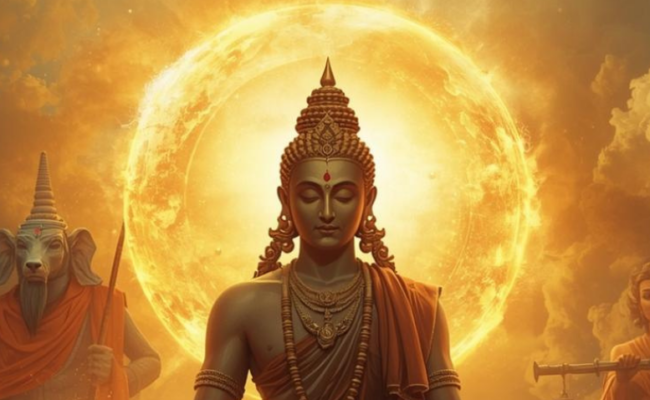
For Tulsidas, Rama was not a distant god seated in heaven.
Rāma was presence itself.
Compassion in action.
Dharma in human form.
Grace made visible.
To remember Rāma was to align with truth.
To chant His name was to quiet the mind.
Tulsidas did not merely believe in Rāma.
He lived in relationship with Him.
The Gift of the Ages — Ramcharitmanas
The Ramcharitmanas is not just a retelling of the Ramayana.
It is a re-experiencing.
By composing it in Awadhi, Tulsidas brought sacred knowledge out of exclusivity and into everyday life.
Villagers, families, and ordinary people could now engage with the story of Rāma in their own language.
But more than accessibility, he infused it with emotion.
The text does not just narrate events.
It invites the reader to feel devotion, surrender, and divine love.
The Power of the Divine Name
For Tulsidas, the Name of Rāma held transformative power.
Not as superstition.
But as subtle truth.
The mind is constantly repeating something —
worry, memory, desire.
Replace that repetition with the Divine Name,
and the inner atmosphere changes.
The Name becomes anchor.
The Name becomes refuge.
In constant remembrance, the restless mind begins to soften,
and the heart naturally turns inward.
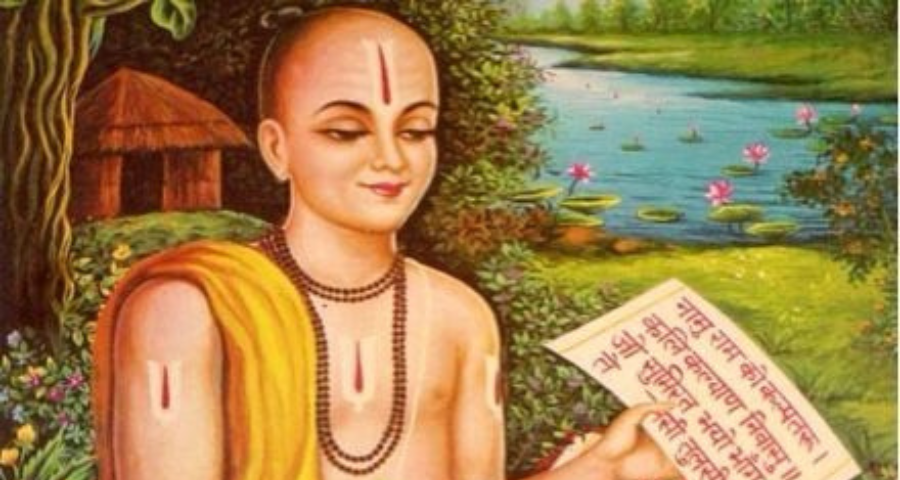
Bhakti Over Intellectual Pride
Tulsidas respected knowledge, but he saw its limitation.
Knowledge can inform.
But it can also inflate the ego.
Devotion, however, dissolves it.
A learned person may speak beautifully about truth.
But a devotee lives it silently.
For Tulsidas, humility was greater than scholarship.
Because truth is not reached by argument —
it is received through openness.
Suffering as Refinement
Life, in Tulsidas’s view, is not meant to be free of difficulty.
It is meant to be transformative.
Suffering exposes attachments.
It reveals where we are still holding on.
Instead of resisting pain, Tulsidas invites us to observe it:
What is this experience teaching?
Where is the attachment behind it?
In that inquiry, suffering becomes a teacher rather than an enemy.
The Simplicity of True Devotion
Tulsidas’s teachings are striking in their simplicity.
No complex systems.
No rigid requirements.
Just sincerity.
To remember God with love.
To speak truthfully.
To act with kindness.
This simplicity makes his path accessible to everyone.
Because devotion does not require perfection —
it requires honesty of heart.
Grace — The Invisible Support
Effort alone cannot complete the spiritual journey.
There comes a point where something beyond personal effort begins to guide.
Tulsidas calls this grace.
It cannot be forced.
It cannot be demanded.
But it can be received.
A humble heart, a sincere intention, and a steady remembrance —
these invite grace naturally.
Seeing the Divine Everywhere
Tulsidas did not limit God to temples or rituals.
He saw Rāma in everything.
In people.
In nature.
In moments of silence.
When perception becomes pure,
the division between sacred and ordinary disappears.
Life itself becomes continuous worship.
Liberation — Love Without Separation
For Tulsidas, liberation is not escape from the world.
It is freedom from separation.
As long as there is “I” and “God” as two,
there is distance.
But when devotion deepens,
that distance dissolves.
Only love remains.
And in that love, there is no bondage —
only completeness.
The Teaching — Remember, Even in the Ordinary
Tulsidas does not ask you to leave life behind.
He asks you to transform how you live it.
While walking — remember.
While working — remember.
While speaking — remember.
Spirituality is not confined to special moments.
It is woven into the ordinary.
The more naturally remembrance flows,
the closer one lives to truth.
The Living Legacy of Tulsidas
Centuries have passed, yet Tulsidas remains alive through his words.
His verses are still sung in homes, temples, and gatherings.
Not because they are old —
but because they are timeless.
They continue to comfort, guide, and awaken.
Because they speak not to the intellect alone,
but directly to the heart.
🕉️ Closing Reflection — The Name Within You
Tulsidas leaves us with a simple, powerful truth:
You do not need to become something new.
You only need to remember what is already present.
The Divine is not distant.
It lives in the space of awareness,
in the silence between thoughts,
in the love you are capable of feeling.
If even once, with sincerity,
you remember the Name of Rāma —
that moment becomes sacred.
And in that sacredness,
the journey is already fulfilled. 🌺✨