
The Kena Upaniṣad — Where the Seeker Is Stopped Before They Begin 🌿
Most sacred texts begin by describing reality, prescribing duty, or revealing truth.
The Kena Upaniṣad does none of these. It begins with a disturbance.
“By whom commanded does the mind go toward its objects?
By whose will does the prāṇa function?
At whose direction do speech, sight, and hearing operate?”
This is not theology. This is a dismantling of assumption. Before the seeker can believe, act, worship, travel, or experience—
the Kena Upaniṣad asks them to pause and confront a more unsettling inquiry:
Who is truly the doer behind all doing?
Rooted in the Sāma Veda, the Veda of vibration and inner resonance 🎶, the Kena Upaniṣad is less a scripture and more a tuning of perception. It does not give answers; it refines the instrument that seeks them. For SanathanaYatra, this is foundational.
A journey that begins without questioning the seer becomes sightseeing. A journey that begins without questioning the doer becomes activity. A journey that begins without questioning perception becomes consumption.
Kena teaches that before movement, there must be awareness of what moves. Thus, SanathanaYatra does not begin with destinations.
It begins with stilling the impulse to rush toward them.

The Kena Upaniṣad in Motion — Training the Traveler Before the Travel 🧭
👁️ Who Is Seeing? — Re-educating Perception
Kena declares that the eyes do not truly see, the ears do not truly hear, and the mind does not truly think. These are instruments animated by a deeper intelligence 🌌.
Modern travel overwhelms these instruments. Colors, sounds, movement, noise, crowds, constant visual capture. The senses are overstimulated until they lose subtlety. SanathanaYatra reverses this.
Before entering a temple, there is pause.
Before explanation, there is observation.
Before photography, there is darśana. 🪔
Travelers are guided to notice how they perceive before what they perceive.
This refinement produces a rare shift:
🌿 Seeing without grabbing
🌿 Hearing without reacting
🌿 Moving without rushing
The world reveals itself differently when perception is quiet.

⚡ The Power Behind Power — Dissolving Spiritual Ego
In the famous Yakṣa episode, the gods win a victory and assume it is their own. A mysterious presence appears. Agni cannot burn a blade of grass. Vāyu cannot move it. Indra cannot comprehend it. They realize: their power is borrowed ⚡.
SanathanaYatra treats this as a central pilgrimage truth.
No guide claims authority.
No narrative claims ownership.
No traveler is made to feel like a conqueror of destinations.
Sacred places are approached with humility because they do not exist for us. We enter them as participants in a much older continuity.
This cultivates:
🕊️ Humility before heritage
🕊️ Reverence without dominance
🕊️ Participation without entitlement
The ego that travels to collect experiences is gently replaced by the seeker who travels to dissolve assumptions.
🌫️ “He Who Thinks He Knows, Knows Not” — Guarding the Sanctity of Mystery
The Kena Upaniṣad opens with a quiet shock to spiritual certainty. It declares that truth is closest to those who do not claim possession of it, and farthest from those who believe they have grasped it. Knowledge, here, is not accumulation but humility. SanathanaYatra protects this insight by ensuring that pilgrimage never hardens into spiritual intellectualism.
Information is offered gently, never aggressively 🪶. Context is shared, but not exhaustively. Explanations are allowed to taper into silence. Some symbols are intentionally left unresolved, not because they cannot be explained, but because premature explanation closes deeper doors. Mystery is not treated as a failure of understanding—it is honored as a living presence.
By refusing to over-interpret sacred geography, SanathanaYatra prevents holy places from becoming academic exhibits. Travelers are encouraged to sit with what cannot be neatly resolved. In that stillness, reverence deepens. Mystery becomes not a gap in knowledge, but a doorway into perception.
🧘 Training Attention Instead of Feeding Appetite
The Kena Upaniṣad reminds us that the senses cannot grasp the source that empowers them. Sight cannot see its own origin, and sound cannot hear the intelligence behind hearing. That source reveals itself only when sensory hunger quiets and attention turns inward. Modern travel overstimulates instead, leaving one saturated in experience yet inwardly empty.
SanathanaYatra reverses this pattern by treating restraint as wisdom, not deprivation. Journeys are shaped with intentional sensory discipline 🌄, not constant stimulation. Long, silent views replace commentary, and landscapes are allowed to speak for themselves. Travel becomes less about input and more about attunement.
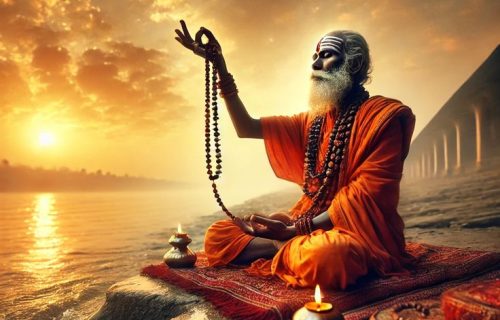
Riverbanks invite stillness rather than performance 🌊, asking travelers to sit and listen. Temple courtyards are entered without rush, honoring the rhythm of the space 🛕. Night skies remain unprogrammed—no agenda, no narration, only vast presence 🌌. Each setting gently withdraws excess so attention can return to itself.
🌑 The Sacred Moment of Not Understanding
In the Kena Upaniṣad, the gods themselves encounter confusion before insight dawns. Their inability to comprehend becomes the threshold of realization. SanathanaYatra treats such moments not as obstacles, but as sacred pauses.
When travelers encounter unfamiliar rituals, unexplained customs, or silent traditions, they are not rushed toward resolution. They are invited to remain with the experience. Discomfort is not dismissed. Uncertainty is not patched over with quick answers.
In these moments, confusion becomes instruction. Ego loosens. Expectation dissolves. Insight often enters precisely where explanation fails. What cannot be understood immediately begins to work inwardly, reshaping perception.
🌞 Knowledge That Changes Conduct
The Kena Upaniṣad concludes by showing that true knowledge expresses itself not in speech, but in conduct. Wisdom is recognized not by what is declared, but by how one moves through the world. SanathanaYatra extends this teaching into every layer of the journey.
Each step becomes a quiet test of awareness made visible through action.
Respect for local communities 🤝 is not optional; it is foundational. Care for ecology 🌿 is practiced, not preached, through conscious choices. Patience in ritual spaces 🕯️ is cultivated, not demanded. Sacred paths are walked mindfully, not hurriedly 🚶.
Pilgrimage becomes a training ground for how one lives after returning. The journey refines behavior, not just belief or vocabulary. Knowledge proves itself through gentleness, restraint, and responsibility. What is learned on the road quietly reshapes everyday life.
🌈 One Intelligence, Many Traditions
The intelligence that moves breath and mind is not confined to a single expression.
SanathanaYatra honors Hindu, Buddhist, Jain, Sikh, and indigenous traditions as distinct yet related inquiries into the same mystery.
Difference is preserved, not flattened. Unity is not imposed; it is discovered.
When intelligence is recognized everywhere, fear dissolves naturally. Diversity becomes resonance rather than division.
🌬️ Journey as Living Question
The Kena Upaniṣad does not hand down conclusions. It leaves the seeker with a refined question, sharpened awareness, and deepened humility. SanathanaYatra designs journeys in this same spirit.
Travelers repeatedly encounter subtle inquiries:
Who is seeing this temple?
What draws me toward this river?
What remains when interpretation falls silent?
The seeker returns not with answers, but with depth. Not with certainty, but with clarity.
🕉️ SanathanaYatra — The Kena Upaniṣad Walked
SanathanaYatra makes the Kena Upaniṣad experiential.
Not as doctrine.
Not as explanation.
But as perception refined through movement.
Scripture becomes question.
Question becomes path.
Path becomes awareness.
The journey does not promise answers.
It makes one capable of recognizing That by which all answers arise.